
Frequently Asked Questions
Here are our most asked questions, if there’s anything you would like to know that is not covered below, please don’t hesitate to use the contact form at the bottom of this page to get in touch directly and we will do our best to help.
FAQ for Learners and Apprentices
Do I have to pay for the courses?
Apprenticeships are funded courses that are paid for by employers. Apprentices must work 30 or more hours per week at their apprenticeship to be considered full time. Some apprenticeships can help you get into childcare and education if you have no previous experience or training and others require the apprentice to have experience working with children. It is sometimes possible to do a part-time apprenticeship, which increases the length of the childcare course. Continuing Professional Development courses are self-funded.
Who is eligible for an apprenticeship?
Apprenticeships are available through employers in England for candidates who are 16 years old or older and don’t have an equivalent or higher qualification. Apprentices must be ordinary residents in the UK for three years prior to the start of the apprenticeship. For questions on eligibility criteria see Annex A of the Apprenticeship funding rules.
What qualifications do I need to apply for the apprenticeship?
Each course has its own prerequisites. Please see the course page for specific requirements, below is an overview of qualifications required to enrol in some of our most popular apprenticeships
- Level 2 (L2) – none
- Level 3 (L3) and L3TA – diagnostic test in English and maths with an equivalent score of level 1 (L1) as level 2 (L2) English and maths courses are taken concurrently during the apprenticeship if the apprentice has not completed them already. Having an L2 childcare certificate is NOT a requirement to enrol in L3.
- Level 4 (L4) residential – diagnostic test in English and maths with an equivalent score of level 1 (L1) as level 2 (L2) English and maths courses are taken concurrently during the apprenticeship. Having an L3 childcare certificate is NOT a requirement, but having experience in the classroom is required.
- Level 5 (L5) – Level 3 (L3) for maths and English. L3 childcare certificate is NOT a requirement.
- Level 6 (L6) – Bachelors of science or arts degree in any subject including at minimum L1 maths and English
How long does the apprenticeship program last?
Per government regulations each apprenticeship must be a minimum of a year and one day and up to two years for L5. It is possible to complete the apprenticeship in less than two years but not less than one.
Will I be paid during the apprenticeship?
Yes, all of our apprentices are paid during their apprenticeship. The minimum apprenticeship rate if you are unqualified is £5.28 for the first year although some employers pay more. If you are completing your apprenticeship with your current employer you will receive your normal salary throughout. Please see each apprenticeship vacancy for up to date wage information.
Can I continue my education after completing the apprenticeship?
Yes, all courses lead naturally to the next level of qualification up to Level 6. Please see the course page for requirements or reach out to your tutor to discuss your continuing education options.
Will I receive a recognised qualification at the end of the apprenticeship?
Yes, you will receive a recognised, relevant qualification awarded by statutory examining bodies which will qualify you to take on specific roles per your qualification. Depending on your apprenticeship you will be fully qualified to work with children in a school classroom or early years setting to be counted in the child to qualified practitioner ratio.
What is my chance of full employment after completing my apprenticeship?
Many employers opt to hire apprentices upon completion of their qualifications. While employment with your apprenticeship placement is not guaranteed, Orange Moon will support you with your career in childcare or a school setting by sharing open vacancies and mentoring you in the field. Read the testimonials of former Orange Moon apprentices here.
How do I apply for an apprenticeship?
Visit link to apply for an apprenticeship. Our tutors will help you with any questions about your application or which apprenticeship is right for you. You will need to have an email address and create a teacher training account through Gov.UK.
Is there support available during the apprenticeship?
Yes, each learning has an allocated tutor who will support you and visit you once or twice per month for the duration of your apprenticeship. There are also virtual group teaching sessions where you will interact with other apprentices and your tutor. If you have questions between observations and online teaching sessions, your tutor will be available via text, phone call, or email. We make every effort to meet the needs of learners and their learning styles. If you have additional needs we can accommodate extra time, facilities, and resources. As a small company Orange Moon prides itself on having a friendly, personal team. Get in touch to discuss specific support for your program.
What are the benefits of choosing an apprenticeship over traditional education?
For some learners who have been out of school for a long time or aren’t interested in continuing transition classroom learning, an on-the-job experience can be a great alternative to further your career. For credentials that require employment experience, your apprenticeship counts toward years on the job, so you can get further faster while being paid to learn. If you prefer a hands-on approach that lets you learn while you work, an apprenticeship may be a good option for you.
Will I need to pass an exam as part of my apprenticeship?
Each course has an end-point assessment that may consist of a combination of a multiple choice knowledge test, professional discussions, observations of practice by your mentor, and/or a case study and presentation. The specific exam formats are course dependent. Please refer to individual course requirements or reach out to us to learn more.
Are there other benefits to completing an apprenticeship?
Yes, other benefits of completing an apprenticeship including completing your maths and English qualification if you haven’t already earned a Level 2. You’ll also be paid a wage while studying. Some learners find the hands-on way of learning suits their learning style better and is less stressful and tedious than traditional classroom learning.
What are “off the job” hours?
If your apprenticeship is 30 hours a week, that will include six hours per week of “off the job” hours. These hours include job shadowing (watching and learning a qualified employee perform a job skill), course work, in-class hours with your tutor and fellow learners, and meeting with your work place mentor to discuss your progress. The remaining 24 hours are “on the job” hours working with children or young adults in a nursery, classroom, or other professional setting. In some apprenticeships, these off the job hours are flexible and variable, in others they are set. For example, the off the job hours for the PGTA are always six hours on Fridays.
FAQ for Employers
What is the structure and curriculum of the Orange Moon apprenticeship program?
Each program is specifically tailored to the role and requirements of the apprenticeship. Childcare apprenticeships are generally one to two years long. Apprentices work in childcare and schools 30+ hours per week and attend group childcare training sessions in line with government requirements with learner support throughout. Learn more details about specific programs on the apprenticeship page.
How are apprentices supported and assessed?
Each learner has an allocated tutor who meets with the apprentice in their workplace at least once per month. Virtual group teaching sessions allow apprentices to learn with other apprentices and their mentor. Assignments are submitted and assessed through Orange Moon’s e-portfolio system. Apprentices have regular communication with tutors and learning mentors who are available via text, phone call, or email between teaching sessions and observations. Each course has an end-point assessment that may be a combination of a multiple choice knowledge test, professional discussions, observations of practice by the mentor, and/or a case study and presentation. All assignments and assessments are in line with the standards set by Training Qualifications UK and are administered through EPAPro. Apprentices are supported and encouraged to strive for distinction. Orange Moon makes every effort to meet the needs of learners and their learning styles. If an apprentice has additional needs we can accommodate extra time, facilities, and resources. As a small company Orange Moon prides itself on having a friendly personal team. Get in touch to discuss support for specific programs.
Can you provide information on the qualifications and experience of your tutors?
Our tutors have a wide range of backgrounds with many years of teaching experience in the classroom and nursery setting. They are experts in the field and have a track record of excellence in working with apprentices to teach practical best-practices for working in a classroom setting. We’re listed as a main provider on the Government’s Register of Apprenticeship Training Providers and deliver internationally recognised qualifications and CPD programmes. We provide specialist training to help raise standards across the sector, improve skills, ensure best practice and give the individuals we work with the best platform to develop their careers.
What support do you offer to employers who host apprentices?
Our Communications Lead supports employers and will be your first point of contact for questions about the apprenticeship programs in general, working with Orange Moon and requirements for posting vacancies. Each trainee apprentice is assigned a tutor who can be reached by both the apprentice and employer at any time to answer questions and discuss progress.
What is the process for recruitment and selection of apprentices?
Orange Moon has a robust onboarding system to support you in recruitment and hiring of apprentices. We offer an initial one to one assessment to understand your organisation’s needs so we can best support employers with advertising and hiring candidates. Many of our apprentices are such good fits that they go on to be hired full-time after their apprenticeship ends and they are fully qualified.
Is there flexibility in the programmes for specific employer needs?
Yes, Orange Moon prides itself on being a small, agile company which allows us to be flexible and attentive to your organisation’s specific needs. We work with a wide variety of employers from secondary schools to at home and nursery-based educators. We aim for flexibility in how we support and retain employers. If you have requirements you’d like to discuss, please reach out XXX to discuss your specific needs.
What is the timeline for apprentices to become fully qualified and ready for employment?
The timeline for apprentices to become fully qualified is at a minimum one year and one day per the UK government rules in order to meet government funding guidelines. Once apprentices complete their on the job training, they also need to complete and pass their endpoint assessment. The length of time varies per course and some courses can be completed over a longer time frame as a part-time apprentice. Please see xxx for more info on individual programmes.
How does Orange Moon handle any challenges or issues that may arise during the apprenticeship?
Orange Moon has a team of dedicated staff who are committed to ensuring both apprentices and employers have a positive experience. Our phone lines and inboxes are always open should you have a question or concern that needs to be addressed. We also offer regular feedback surveys and focus groups to make sure we’re meeting your needs and are open to suggestions and improvements. Let us know if you have ideas to share.
Can you provide information on any financial incentives or benefits available for employers who participate in the apprenticeship program?
All Apprenticeship funding is for employers based in England; we do not cover Wales or Scotland for apprenticeships.
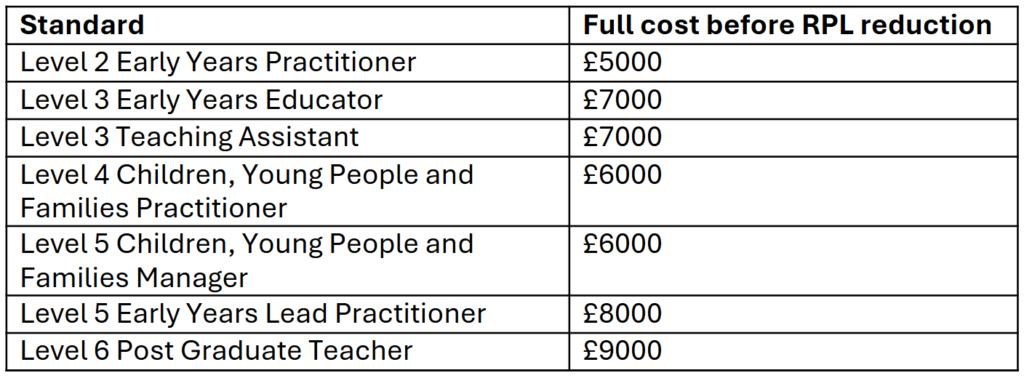
The full maximum costs for employers are before any recognised prior learning (RPL) has been removed, so these can change per apprentice, depending on the existing skills and knowledge the learner already has.
Non-Levy employers pay 5% towards the costs for all learners age 19 or older. Learners age 16-18 are covered at no cost to the employer if the business is non-levy. Businesses with a wage bill under £3 million are classed as non-levy paying. Those above £3 million are levy paying.
What are “off the job” hours
A 30-hour per week apprenticeship includes six hours per week of “off the job” hours. These hours include job shadowing (watching and learning from a qualified employee performing a job skill), course work, in-class hours with a mentor, and meeting with a manager to discuss the apprentice’s progress. The remaining 24 hours are “on the job” hours working with children or young adults in a nursery apprenticeship, classroom, or other professional setting. Employers will receive a timetable in advance for coursework off the job hours when the apprentice will need to be out and cannot be counted for nursery ratios. Other off the job hours may be accrued through daily tasks where the apprentice may be counted in numbers. Contracts for apprentices will include the learning needs for the particular program your apprentice is completing. In some apprenticeships, these are flexible, in the PGTA they are on Friday for six hours.
When can my apprentice start?
The Post Graduate Teaching Assistant (PGTA) program follows the school calendar and starts in September. All other apprenticeships enrol on a rolling basis. Apprentices can start at any time with the average time from application to apprentice placement being four to eight weeks after initial paperwork is completed.
Want to get in touch?
Orange Moon Training
6 Sherwood Rise
Nottingham
NG7 6JF
Telephone
0115 784 3980
e-mail
info@omtraining.co.uk
